
Precision Immunotherapies Require Functional Insights
The development of precision immunotherapies against solid tumors requires us to overcome the fundamental challenges, from identifying differentiated targets, to finding highly functional therapeutic binders, to predicting potential safety risks before candidates reach the clinic. However, addressing these challenges demands functional insights at the single-cell level and an integrated approach.
.svg)
.png)
What We Do
We are developing next generation T Cell Engagers for solid tumors through a unified technology engine spanning target discovery - PINTRATM, ultra-high-throughput microfluidics-driven functional screening - TCELERATORTM, computational therapeutics design and predictive safety assessment - SERISTM. This engine is grounded in real biology validated in our wet lab, and built on top of proprietary human tumor datasets spanning more than 10,000 tumor samples and more than 11M single cells. It allows us to shorten the development timeline and generate TCEs with optimal properties.




.png)


















A Unified Engine
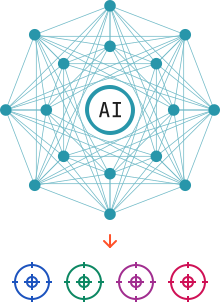
Proprietary Dataset and Advanced AI Engine to Pinpoint Optimal Targets: PINTRATM
PINTRATM integrates multiple dimensions of data from a large set of tumor and normal samples. It enables us to identify therapeutically relevant, differentiated surface and intracellular targets for solid tumors, providing a therapeutic path for patients with limited or no treatment options.

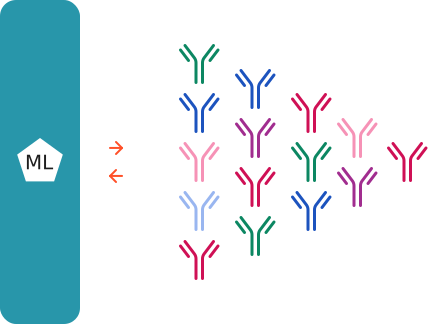
Computational Protein Design and Optimization to Generate the Best Binders: AFFINISTM
AFFINISTM dissects protein geometry and models molecular interactions computationally to design binders and further optimize them through reinforcement learning, while simultaneously tune other properties to enhance and ensure the molecules' developability.
.svg)
Ultra-high Throughput Functional Screening to Find the Therapeutic Leads: TCELERATORTM
TCELERATORTM functionally profiles more than 10 million single cell interactions at once. Where conventional discovery tests binders sequentially over months, it identifies functional leads in a single experiment. The platform now screens TCE binders and formats directly, ranking binders and molecular geometries by their functions rather than by binding affinity alone.
AI-Driven Deep Molecular Scanning to Predict Potential Adverse Reactivity for Clinical Safety: SERISTM
SERISTM computionally screens epitope interactions of the TCE candidates with normal human tissues to look for potential cross reactivity. This approach has enabled us to successfully predict previously reported clinical toxicities to the tissue/organ, providing a powerful safeguard for our TCE design process.
.svg)


